
confidential-computing Securing Trust: RATS and Attested TLS (aTLS)

Jovan Djukic
· 10 min read
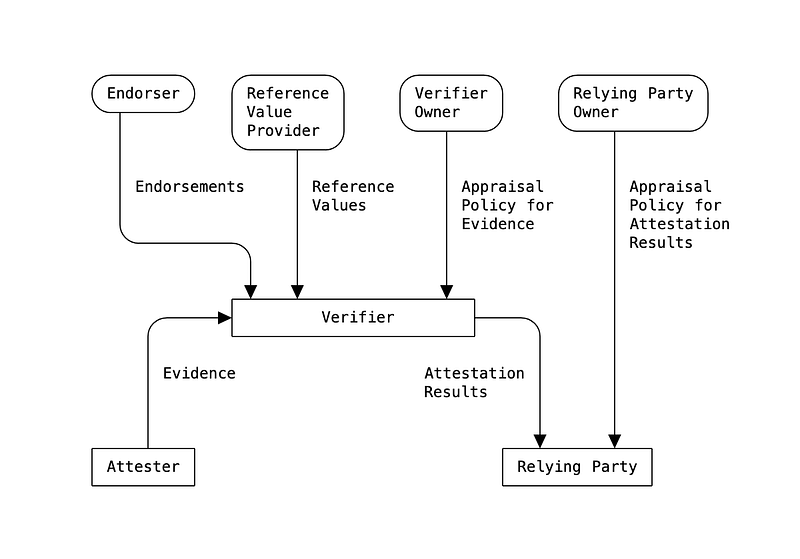
In this article, we’ll explore Remote ATtestation procedureS (RATS), an IETF standard that defines how systems can securely prove their integrity and operational state to others. We’ll break down the key components of the RATS architecture, explain how evidence and attestation results are exchanged, and discuss its relevance in establishing trust between devices and services. Building on this foundation, we’ll dive into Attested TLS (aTLS), which integrates remote attestation directly into the TLS handshake. Finally, we’ll look at how these concepts are implemented in COCOS AI, demonstrating how RATS and aTLS enable secure, verifiable communication between clients, servers, and trusted execution environments (TEEs).
Remote ATtestation procedureS (RATS) - The Architectural Backbone
Remote ATtestation procedureS (RATS), defined in RFC 9334, provide a standardized architecture for proving the trustworthiness of a device, workload, or service. At its core, RATS enable one system to produce verifiable evidence about its current state, while another system evaluates this information to decide whether to trust it. In an age where workloads run on untrusted infrastructures and sensitive computations happen in shared environments, having a portable and interoperable way to prove integrity has become essential.
RATS define several key roles in this process:
1. The Attester is the entity that generates Evidence about its own operational state.
- Runs in a TEE, device, confidential VM, or enclave.
- Produces measurements like firmware hashes, kernel versions, or PCR values from a TPM.
- Uses Attestation Keys bound to hardware or firmware to sign this evidence.
2. The Verifier evaluates the Evidence received from the Attester.
- Uses Endorsements (e.g., TPM vendor certificates) and Reference Values (known-good measurements) to check validity.
- Produces an Attestation Result - a signed statement about the Attester’s trustworthiness.
- Often operated by a trusted authority, like a cloud provider or security service.
3. The Relying Party consumes the Attestation Result from the Verifier and makes trust decisions. Examples:
- A cloud orchestration platform deciding whether to schedule workloads on a VM.
- A client deciding whether to connect to a server running inside a TEE.
- Does not need to understand raw evidence, only the Verifier’s signed results.
4. The Endorser vouches for the trustworthiness of an Attesting Environment by providing Endorsements. Typically the hardware or firmware vendor. Examples:
- Intel SGX/TDX provisioning services signing enclave keys.
- AMD providing ARK and ASK certificates for SEV-SNP.
5. The Reference Value Provider supplies Reference Values - known-good measurements used by the Verifier. Ensures the Verifier knows what a “trusted state” looks like. Examples:
- BIOS vendors providing approved firmware hashes.
- Container registries providing signed digests of container images.
6. The Verifier Owner defines appraisal policies for a device or environment. Determines what evidence matters and what constitutes a trustworthy state. Could be:
- A cloud tenant defining which OS images are approved.
- An IoT fleet operator defining minimum firmware requirements.
7. Relying Party Owner (optional, less explicit). Some deployments separate the Relying Party from the Relying Party Owner:
- The Relying Party executes policy decisions.
- The Owner defines those policies.
This distinction matters in multi-tenant or cloud scenarios where service providers enforce policies defined by customers.
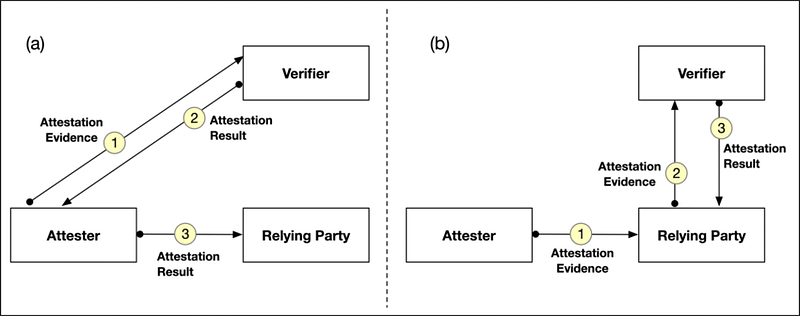
To support different deployment models, RATS describe two primary patterns: the passport model and the background-check model. In the passport model (left picture), the Attester communicates directly with the Verifier, obtains the attestation result, and then presents this “passport” to the Relying Party. In contrast, the background-check model (right picture) shifts more responsibility to the Relying Party - it sends the evidence to the Verifier itself, ensuring independent validation. This flexibility allows RATS to fit into diverse ecosystems, from cloud platforms to IoT devices.
Another important aspect of RATS is its layered and composite attestation model. Modern systems often consist of multiple components, each capable of measuring and attesting to the state of the next layer. For example, a device’s BIOS might measure the bootloader, the bootloader measures the kernel, and the kernel measures user-space workloads. RATS provide a way to structure this chain of trust so that relying parties can evaluate integrity from the hardware level all the way up to applications.
Security in RATS goes beyond exchanging evidence. The architecture considers freshness, ensuring that attestation results cannot be replayed or reused maliciously. Mechanisms like nonces, secure clocks, and epoch identifiers are critical here. Equally important is the secure handling of attestation keys - compromising these would undermine the entire trust model. By combining cryptographic proofs, policy evaluation, and carefully designed message flows, RATS establish a portable framework for secure, cross-vendor attestation.
In essence, RATS solve one of the hardest problems in distributed computing: how to trust a remote system without physically inspecting it. Whether you’re securing IoT devices, protecting cloud workloads, or enabling confidential computing, RATS provide the architectural foundation for verifiable trust at scale.
From TLS to aTLS: Embedding Trust into Secure Channels
TLS Recap - The Foundation of Secure Communication
Transport Layer Security (TLS) is the backbone of secure communication on the internet. It establishes an encrypted channel between two parties - typically a client and a server - ensuring that data exchanged cannot be intercepted or modified.
In a standard TLS 1.3 handshake:
- The client and server negotiate encryption parameters.
- The server presents an X.509 certificate proving its identity.
- The client validates this certificate against trusted Certificate Authorities (CAs).
- Both parties derive a session key to encrypt all subsequent communication.
This model provides confidentiality, integrity, and authentication. But there’s a problem: TLS certificates only prove identity, not trustworthiness.
For example, a server can present a valid certificate while running outdated firmware or malicious code, and the client has no way of knowing. In highly sensitive environments - like confidential computing, IoT, and secure AI workloads - this isn’t enough.
What Is aTLS? - Attested TLS
Attested TLS (aTLS) extends TLS by embedding remote attestation into the TLS handshake, enabling endpoints to prove not just who they are, but also how they are running.
With aTLS, the TLS certificate - or an additional handshake extension - includes attestation evidence or attestation results. This allows one party to verify not only the cryptographic identity of the other, but also:
- Whether it’s running in a Trusted Execution Environment (TEE).
- Whether the firmware and software stack match known-good configurations.
- Whether security policies are being enforced.
This builds on the RATS architecture defined in RFC 9334, which standardizes how evidence, endorsements, and attestation results are produced and consumed.
How aTLS Uses RATS
aTLS doesn’t invent a new attestation framework - it integrates RATS into TLS. The flow depends on which RATS model is used. The Passport Model in aTLS has the following steps:
- The Attester (e.g., a TEE-enabled server) contacts a Verifier before the TLS handshake.
- The Verifier evaluates evidence and returns an Attestation Result - essentially a signed “passport.”
- During the TLS handshake, the Attester embeds this result into its TLS certificate.
- The client (Relying Party) validates the attestation result and decides whether to trust the session.
The Background-Check Model in aTLS has the following steps:
- The client (Relying Party) requests attestation during the TLS handshake.
- The Attester sends raw evidence rather than pre-verified results.
- The client forwards this evidence to a Verifier in real time.
- The Verifier issues an Attestation Result, which the client uses to decide whether to proceed.
This flexibility makes aTLS suitable for cloud workloads, IoT deployments, and secure AI environments - each with different trust relationships.
The Bigger Picture
By combining TLS with RATS, aTLS transforms “secure communication” into “secure and verifiable communication.” It ensures that:
- Who you’re talking to is verified.
- What they’re running is trustworthy.
- How your data is handled respects your security policies.
This is especially critical for confidential computing, where trust must extend beyond identities to include the state of the runtime environment.
Real-World Example - Confidential Computing & AI in COCOS AI
Cocos AI is an advanced platform that leverages Confidential Computing and Trusted Execution Environments (TEEs) to enable secure multiparty computation (SMPC). Within its architecture, the Agent operates inside a TEE and plays a crucial role in establishing an attested TLS (aTLS) connection with the CLI, ensuring both secure communication and runtime integrity.
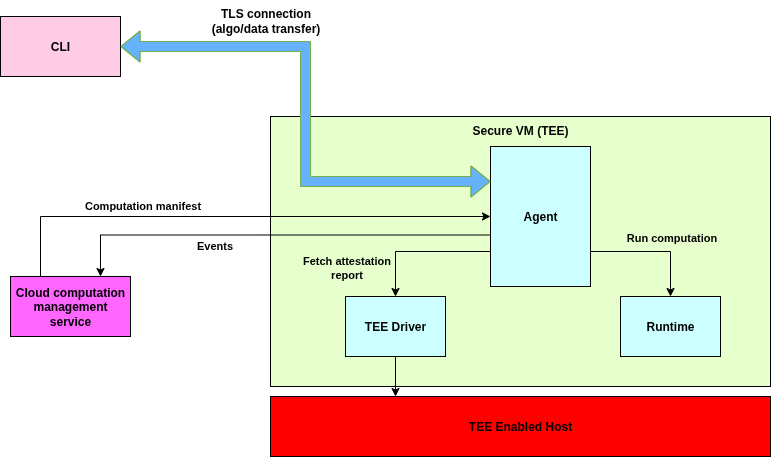
COCOS AI adopts the RATS background-check model for remote attestation. During certificate creation, the attestation report is embedded directly into the X.509 certificate by passing it through the Certificate Signing Request (CSR) and including it in the issued certificate. The following Go snippet demonstrates how the CSR is generated.
csrMetadata := certs.CSRMetadata{
	Organization:    []string{p.subject.Organization},
	Country:         []string{p.subject.Country},
	CommonName:      p.subject.CommonName,
	Province:        []string{p.subject.Province},
	Locality:        []string{p.subject.Locality},
	StreetAddress:   []string{p.subject.StreetAddress},
	PostalCode:      []string{p.subject.PostalCode},
	ExtraExtensions: []pkix.Extension{extension},
}

csr, sdkerr := p.certsSDK.CreateCSR(ctx, csrMetadata, privateKey)
if sdkerr != nil {
	return nil, fmt.Errorf("failed to create CSR: %w", sdkerr)
}
Once the certificate is obtained, a standard TLS connection can be established. The key difference compared to a regular TLS setup is the inclusion of a custom verification function for the X.509 certificate. This function ensures that the embedded attestation extension contains a valid attestation report.
The following Go snippet demonstrates how to configure TLS to perform this additional verification step.
tlsConfig := &tls.Config{
	InsecureSkipVerify: true,
	RootCAs:            rootCAs,
	ServerName:         sni,
	VerifyPeerCertificate: func(rawCerts [][]byte, verifiedChains [][]*x509.Certificate) error {
		return atls.NewCertificateVerifier(rootCAs).VerifyPeerCertificate(rawCerts, verifiedChains, nonce)
	},
}
Note: setting InsecureSkipVerify: true disables Go’s built‑in certificate
verification. In this aTLS setup, that is intentional because
VerifyPeerCertificate replaces the default verifier so it can both
perform all the usual checks (build and validate the certificate chain
against rootCAs, verify the peer identity via ServerName/SAN,
check validity periods, key usage, etc.) and validate the embedded
attestation evidence. Do not copy this configuration without
implementing full certificate and hostname/SAN validation in your own
VerifyPeerCertificate callback, otherwise TLS certificate checks will
effectively be disabled.
The behavior of the VerifyPeerCertificate function, which verifies the attestation extension,
depends on the underlying platform, such as AMD SEV-SNP or
Intel TDX.
Conclusion
As workloads move to untrusted environments like public clouds and edge platforms, securing communication is no longer just about encryption - it’s about verifiable trust. This is where RATS and aTLS come together.
RATS provides the architectural framework for generating, evaluating, and sharing attestation evidence, while aTLS seamlessly integrates this attestation into the TLS handshake. The result is not just secure communication, but communication where each party can prove its integrity and runtime state before exchanging sensitive data.
COCOS AI builds on this foundation by leveraging Confidential Computing and Trusted Execution Environments to enable secure multiparty computation. By adopting the RATS background-check model and embedding attestation reports directly into X.509 certificates, COCOS AI ensures that every connection is both encrypted and verifiably trusted.
As technologies like confidential computing and secure AI continue to evolve, approaches like RATS + aTLS are set to become a cornerstone of next-generation security architectures - enabling us to build systems where trust is cryptographically enforced, not just assumed.